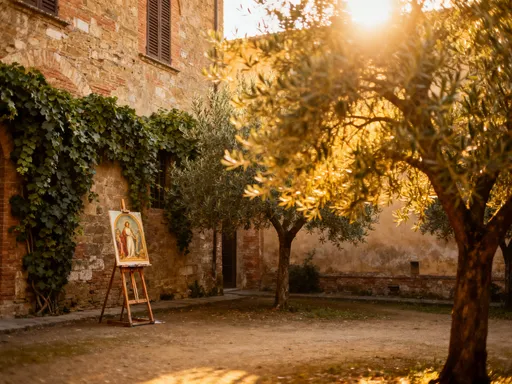
Siena isn’t just about medieval streets and palazzos—it’s alive with art that pulses through its hidden courtyards, quiet chapels, and family-run studios. I wandered without a map and stumbled into spaces where Renaissance whispers blend with modern creativity. This is immersive travel at its finest: unplanned, intimate, and deeply human. Forget the crowds—let me show you the Siena artists dream of.
The Soul of a Living Canvas
Siena does not display art—it lives inside it. Unlike cities where masterpieces are sealed behind glass and velvet ropes, Siena’s creative spirit flows through alleyways, courtyards, and the daily rhythms of its people. The city is a living canvas, painted not once, but continuously, by generations who see art not as decoration but as devotion. While most travelers flock to the Duomo or the Palazzo Pubblico, the soul of Sienese artistry beats strongest in places untouched by guidebooks: a weathered chapel tucked between bakeries, a sculptor’s hand shaping terracotta in a centuries-old workshop, a fresco glowing behind a half-open wooden door.
What sets Siena apart is how seamlessly the past and present coexist. The traditions of the 14th-century Sienese School—known for its emotional depth, spiritual intensity, and masterful use of gold leaf—are not relics confined to museums. They are practiced daily by artisans who inherited their skills from parents and grandparents. In neighborhoods like San Prospero or San Giuseppe, you’ll find painters restoring altarpieces using pigments ground from natural minerals, just as their ancestors did. These are not performances for tourists; they are acts of cultural continuity, quiet and unassuming, yet profoundly powerful.
This living artistry invites a different kind of travel—one that values presence over productivity. Instead of rushing from landmark to landmark, immersion means pausing, observing, and allowing yourself to be drawn into the quiet hum of creation. It means noticing how a local artist adjusts the angle of a brushstroke in a chapel restoration, or how a family-run ceramics studio passes tools from elder to child. In these moments, art becomes a language, and Siena, its fluent speaker.
Beyond the Piazza: Finding Intimate Art Spaces
Most visitors begin and end their Siena journey in the Piazza del Campo, and rightly so—the shell-shaped square is a masterpiece of medieval urban design. But to experience the city’s artistic soul, one must step beyond its famous center. Just a few winding streets away lie spaces of breathtaking intimacy and beauty, where art is not curated for spectacle but preserved for meaning. These places do not advertise themselves. They reveal themselves only to those who wander slowly, with eyes open and expectations set aside.
One such sanctuary is the Oratorio di San Bernardino, a modest chapel tucked behind the Basilica of San Francesco. Its walls are covered in a cycle of frescoes by Vecchietta, one of Siena’s most revered Renaissance painters. The scenes depict the life of Saint Bernardino with a tenderness rarely seen in religious art—faces softened by compassion, gestures that speak of humility and grace. The lighting is natural and gentle, shifting throughout the day as sunlight filters through small arched windows. Visitors often sit in silence, not out of obligation, but because the space demands it. The air carries the scent of old stone and beeswax, and the only sound is the occasional rustle of a coat or a whispered prayer.
Equally moving is the former hospital complex of Santa Maria della Scala, now a museum and cultural center. Once one of Europe’s oldest hospitals, it has been transformed with remarkable sensitivity, preserving its original frescoed halls while hosting contemporary exhibitions. The Pilgrim’s Hall, with its 14th-century frescoes depicting scenes of care and healing, is a quiet testament to Siena’s long-standing commitment to community and compassion. Here, art is not separated from life; it is embedded within it, serving as both record and reminder of shared humanity.
These spaces offer a different kind of enrichment—one that comes not from checking a box, but from feeling a connection. They are not grand in scale, but they are immense in emotional resonance. To visit them is to understand that true art does not shout; it whispers, and only those who listen closely will hear.
Meet the Makers: Studio Visits Off the Beaten Path
Some of Siena’s most profound artistic experiences happen not in museums, but in the private studios of its creators. A growing number of local artists welcome curious travelers into their workspaces, offering a rare glimpse into the process behind the finished piece. These visits are not tours in the traditional sense—they are conversations, invitations into a world where creativity is both craft and calling.
I first encountered this spirit at a ceramicist’s atelier near the Church of San Domenico. The studio, housed in a converted 16th-century stable, was filled with the earthy scent of clay and the soft clink of brushes against bisqueware. The artist, a woman in her sixties named Lucia, has spent forty years perfecting the traditional Sienese technique of *terracotta dipinta*, painting intricate floral and geometric patterns onto hand-thrown pottery. Her pigments are still mixed by hand, using natural oxides that yield the deep cobalt blues and warm ochres characteristic of the region. As she worked, she explained how each piece begins with a question: What story should this vessel tell? Who will hold it? Her work is not mass-produced; each item is signed, numbered, and imbued with intention.
Not far away, in a sunlit garage behind a quiet residential street, I met Marco, a young sculptor reinterpreting ancient methods in contemporary forms. Trained in Florence but drawn back to his hometown, Marco works primarily in wood and bronze, drawing inspiration from both Christian iconography and Etruscan motifs. His studio is a place of quiet intensity—shavings litter the floor, tools hang in careful order, and half-finished figures seem to watch from the shadows. He welcomed me not as a customer, but as a listener, eager to discuss how he balances reverence for tradition with the need to innovate. “Art must evolve,” he said, “or it becomes a museum piece, not a living thing.”
Connecting with artists like Lucia and Marco requires more than a Google search. Many do not maintain websites or social media. Access often comes through word-of-mouth, local galleries, or guided studio trails organized by cultural associations. Some studios operate by appointment only, and rightly so—these are workplaces, not attractions. The key is patience and sincerity. A simple email expressing genuine interest, a willingness to listen more than to speak, and respect for their time and process can open doors that no tour bus ever could.
The Language of Frescoes: Understanding Siena’s Visual Heritage
To walk through Siena is to walk through a storybook written in color and form. The city’s frescoes are not merely decorative—they are narratives, sermons, and historical records painted directly onto walls. Understanding their language transforms a casual glance into a meaningful encounter. The Sienese School of painting, which flourished in the 13th and 14th centuries, developed a distinctive style marked by emotional expressiveness, symbolic richness, and a deep sense of spirituality. To see these works without context is to miss their full power.
One of the most striking features of Sienese frescoes is their use of elongated figures. Unlike the balanced proportions of later Renaissance art, Sienese painters stretched bodies and faces to convey spiritual intensity. A raised hand, a downward gaze, a flowing robe—each gesture is carefully chosen to communicate devotion, sorrow, or divine presence. Gold leaf is used not for opulence, but as a symbol of the sacred. When light catches a gilded halo or background, it creates the illusion of divine radiance, lifting the figures out of the earthly realm.
Narrative composition is another hallmark. Fresco cycles often unfold across multiple panels, telling stories in sequence—such as the life of a saint or the founding of the city. These are not passive images; they invite the viewer to follow the story, to move from scene to scene, absorbing the moral and spiritual lessons embedded within. In the Collegiata di Santa Maria, for example, the frescoes by Ambrogio Lorenzetti depict both the Allegory of Good Government and scenes of daily life, blending political philosophy with artistic mastery.
Learning to read these visual stories enhances every visit. Before entering a church or chapel, take a moment to research the artist and the subject. Notice how light falls on certain details—early morning sun might illuminate a particular scene, revealing colors and textures invisible at noon. Ask a local guide or consult a museum pamphlet to understand the symbolism. What appears at first as a simple religious image may, upon closer inspection, be a commentary on justice, community, or the fragility of life. In Siena, every wall has a voice; the trick is learning how to listen.
Timing Your Visit: Seasons, Light, and Local Rhythms
The experience of Sienese art is deeply influenced by when you visit. A fresco seen at midday under harsh sunlight reveals far less than the same painting bathed in the soft, slanted light of late morning. The city’s rhythms—seasonal, liturgical, and communal—shape how and when its artistic treasures are best encountered. Planning with intention can transform a good visit into an unforgettable one.
Spring and early autumn are ideal for travel. The weather is mild, the light is clear, and the city is lively without being overwhelmed by summer crowds. April through June, the hills around Siena turn green and fragrant, and wildflowers bloom along ancient stone walls. During these months, many smaller churches and oratories are open for longer hours, often staffed by local volunteers eager to share their knowledge. October brings the grape harvest and the scent of fermenting wine through the streets, adding a sensory layer to every walk.
But timing also matters on a daily scale. For example, the Oratorio di San Bernardino is best visited around 10 a.m., when sunlight streams through its eastern windows, illuminating Vecchietta’s gold-leaf details with a warm, almost ethereal glow. The same is true for the frescoes in the Church of San Giorgio, where morning light brings out the deep blues and reds in the 15th-century paintings. In contrast, afternoon visits to the Duomo’s Piccolomini Library offer the most dramatic lighting for its famous frescoes by Pinturicchio.
Equally important are the city’s local events. The Palio, Siena’s historic horse race held in July and August, is more than a spectacle—it’s a living expression of civic identity. In the days leading up to the race, the Contrade (neighborhood districts) decorate their streets with banners, murals, and floral arrangements. Artists repaint insignias, restore old paintings, and create temporary installations. Visiting during this time allows travelers to see how art functions as a communal act, deeply tied to pride, memory, and tradition. Even outside the Palio, attending a local feast or religious procession can offer rare access to otherwise closed chapels or private artworks.
Getting There Without the Hassle: Practical Access and Etiquette
Exploring Siena’s hidden art spaces requires more than curiosity—it demands preparation and respect. Many of these sites are not major tourist attractions, and as such, they operate on different terms. Hours may be irregular, entrances unmarked, and information scarce. Navigating them successfully means balancing practical planning with cultural sensitivity.
A key tool is the Siena Museum Pass, which grants access to a network of civic museums, churches, and archaeological sites. While it doesn’t cover every hidden gem, it does include important spaces like the Museo dell’Opera del Duomo and the Santa Maria della Scala complex. Purchasing the pass in advance can save time and money, especially for those planning multiple visits. Additionally, the local tourist office, located near the Palazzo Pubblico, provides up-to-date information on opening times, temporary closures, and special events. Staff are often multilingual and genuinely helpful, offering maps and recommendations beyond the standard brochures.
When visiting smaller churches and oratories, it’s essential to check opening times carefully. Some are only accessible during mass or by appointment. Others rely on volunteer custodians who may not always be present. Arriving too early or too late can mean missing the experience entirely. When in doubt, call ahead or inquire at a nearby shop—locals are usually happy to help. For studio visits, always contact the artist in advance. A respectful email or phone call, written in clear but courteous English, goes a long way. Many artists appreciate the effort, even if they don’t speak fluent English.
Etiquette is equally important. These spaces are often sacred or deeply personal. Dress modestly when entering churches—shoulders and knees covered. Speak in low voices. Photography is permitted in many places, but flash and tripods are often prohibited, especially in frescoed interiors. Always look for posted signs or ask before taking pictures. In private studios, wait for the artist to invite you to photograph their work. Above all, approach each visit with humility. You are a guest in someone’s spiritual or creative space. A simple ‘grazie’ at the end of a visit can leave a lasting impression.
Why Immersion Beats the Checklist
Modern travel often revolves around efficiency—how many sites can you see in a day? How many photos can you collect? But in a city like Siena, where art is woven into the fabric of daily life, this approach falls short. Ticking off landmarks may fill your camera roll, but it leaves the heart untouched. True connection comes not from speed, but from stillness. It comes from sitting in a chapel long after the tour group has left, watching how the light shifts across a fresco. It comes from returning to the same studio twice, not to buy, but to understand.
Immersion means allowing a place to unfold at its own pace. It means attending a weekday mass at San Domenico not for the architecture, but to hear the choir sing in harmony with the sacred images around them. It means striking up a conversation with an elderly custodian who shares the story behind a faded mural—one that isn’t in any guidebook. These moments cannot be scheduled, but they can be invited. They require presence, patience, and a willingness to be surprised.
In Siena, art is not a destination—it is a relationship. It asks for time, attention, and reciprocity. When you give it, you receive something rare: a sense of belonging, even as a visitor. You begin to see the city not as a collection of monuments, but as a living community, where every brushstroke, every chisel mark, carries the weight of memory and meaning. This is the kind of travel that stays with you—not as a memory of what you saw, but as a feeling of what you felt.
The most beautiful thing about Siena’s hidden art spaces is that they are not hiding from you. They are waiting. They do not demand crowds or acclaim. They simply exist, quietly, beautifully, ready to be discovered by those who look with more than their eyes. Let your journey be guided not by maps, but by curiosity. Walk slowly. Listen. And when the city answers—in color, in light, in silence—know that you have found not just art, but its soul.